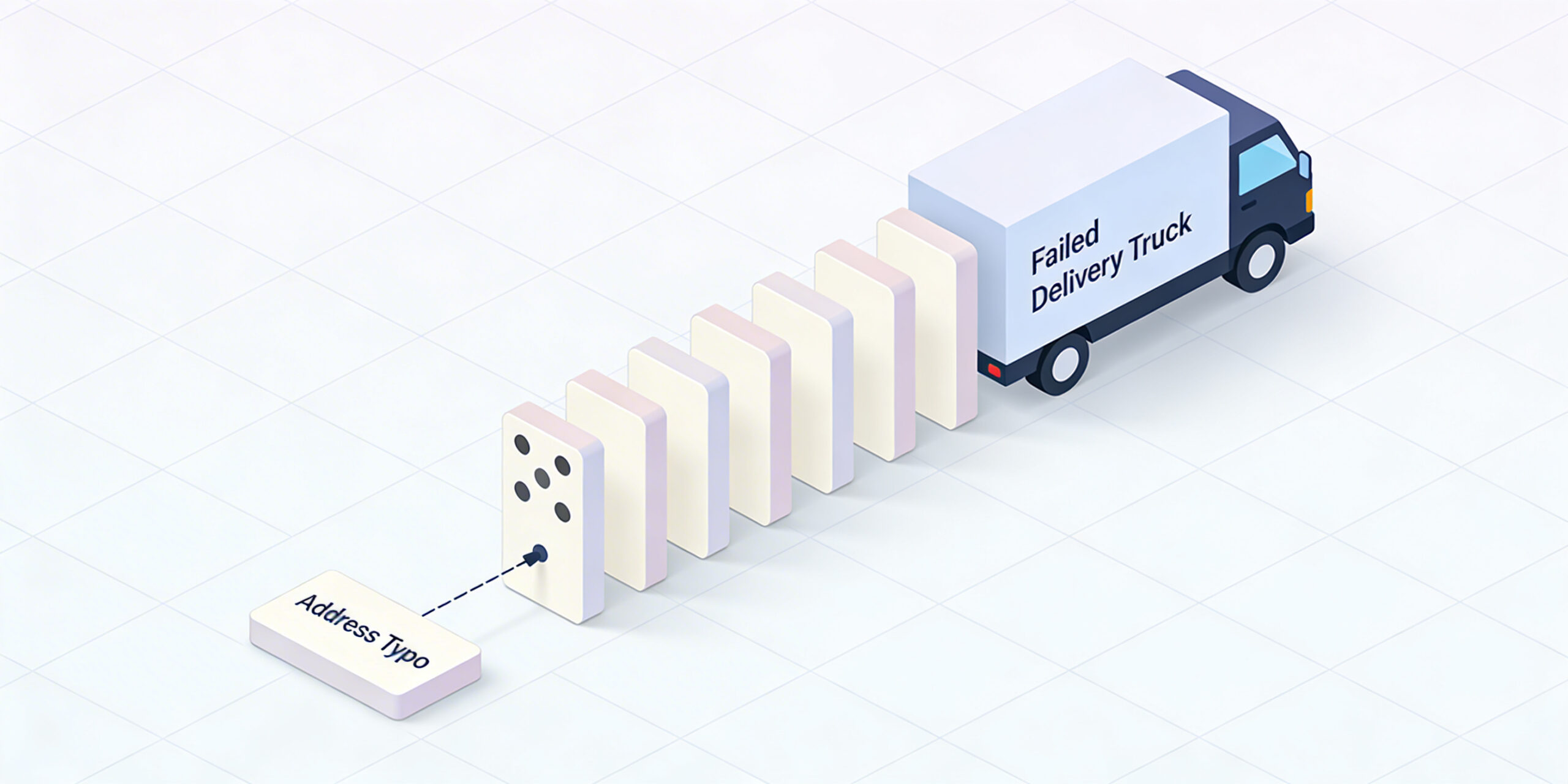

Real talk: your address validation tool is costing you money. You see that little green checkmark at checkout and think you’re safe. But you’re still getting hit with $4.64 carrier correction fees and losing 33% of customers after one failed delivery.
Here’s the thing they don’t tell you: there’s a huge difference between an address that exists and an address that FedEx will actually deliver to. Failed deliveries aren’t just an operational headache. They’re a direct hit to your profit margin and your brand. Let’s break down the damage.
Every single failed delivery costs you, on average, $17.20 in the US. That’s the combined cost of reverse logistics, customer support time, and redelivery fees. Then come the carrier penalties. That small typo you thought was fixed? If it requires a manual correction by UPS or FedEx, they slap you with an address correction surcharge.
These fees add up fast. The worst cost is the one that’s hardest to track: the lost customer. After just one poor delivery experience, a third of your customers will stop buying from you. Forever. All that acquisition spend, gone. You’re probably thinking, “My tool catches typos, I’m good.”
That’s where most e-commerce managers get it wrong. The root cause for up to 25% of all delivery issues is bad address data that a basic tool won’t catch. So, what’s actually happening? Not all “validation” is created equal. The tool you’re using is likely a simple lookup, and that’s the source of your false security. Here’s what you need to know.
Address Lookup
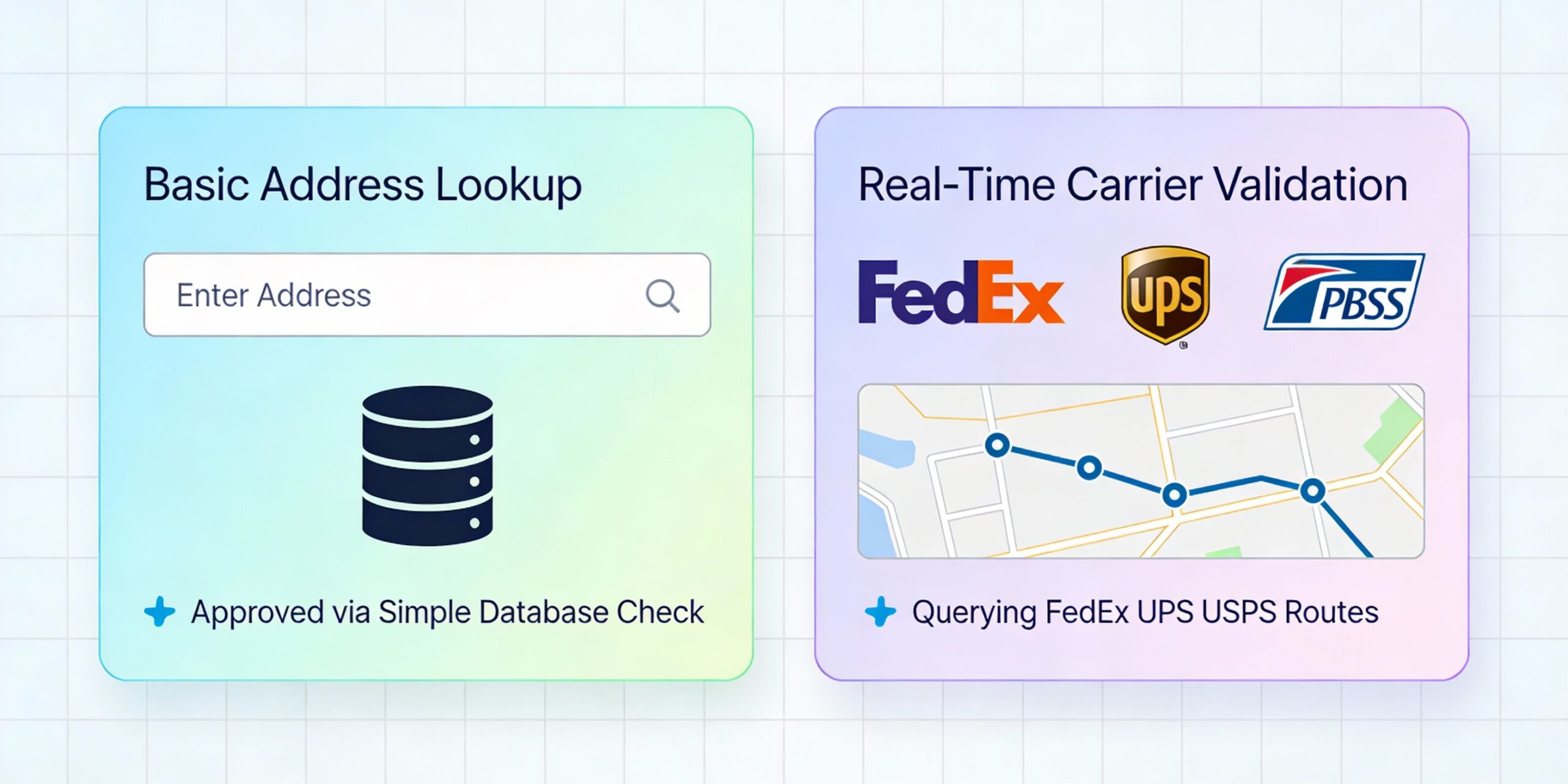
Most platforms offer a basic Address Lookup out of the box. It takes the customer’s input and checks it against a massive national database, usually the USPS master file. It standardizes formatting—changing “St” to “Street.” It’s designed to answer one simple question: “Is this a real place?”
Carrier Validation
Carrier Validation is the game changer. It goes a crucial step further. Instead of just checking a master list, it pings the specific carrier you’re about to use—UPS, FedEx, USPS—in real-time. It asks them a much more important question: “Will you accept this shipment and actually deliver a package here?” That extra step is where you stop losing money.
Why does this matter so much? Because an address can technically “exist” but still be undeliverable. Think about it. A brand-new apartment complex is built. It’s in the city’s records and even the USPS database, so your basic lookup gives it a green light. But the local FedEx hub hasn’t updated its delivery routes yet.
Result? Delivery failure. Or a customer lives in a gated community that only accepts packages at a central mailroom—a detail only the carrier knows. Your lookup tool sees a valid street address, but the driver knows they can’t get to the door. Another failure.
These are not edge cases. They happen every day. An address can be 100% valid on a master list but be flagged as undeliverable by a specific carrier for reasons like a missing apartment number, new construction not yet in their system, or being a PO Box when the carrier doesn’t deliver to them.
This is the gap where your money is disappearing.
The data is clear: addresses that haven’t been validated at the carrier level are 92% more likely to run into shipping problems.
You’re paying for a service that gives you a false sense of security, leading directly to those carrier fines and lost customers. Switching to true carrier validation makes a direct, measurable impact on your bottom line. Studies show that implementing real-time, carrier-grade validation at checkout can prevent between 40% and 60% of all delivery failures.
Let’s connect that back to your pain points. Preventing even 40% of failures means you’re saving that $17.20 cost multiple times over. You’re avoiding those nasty $4.64 correction fees. And you’re keeping that 1 in 3 customers from walking away for good. The ROI is immediate.
There are secondary benefits, too. True carrier validation can identify if an address is residential or commercial. Shipping to a residential address often costs more. By identifying this at checkout, you can charge accurate shipping rates, protecting your margins on every single order. It’s about protecting your profit and your brand reputation. Starting now.
Here’s your next 10-minute action item. Don’t wait for the next quarterly review. Email your tech team or your current address validation provider right now. Copy and paste this exact question:
"Does your tool perform real-time, carrier-grade validation against the databases of our specific carriers (e.g., USPS, FedEx, UPS)?"
If they hesitate, or if the answer is, “We check against the USPS database,” you have your answer. That’s a basic lookup. And you know what you need to do next. That’s it. Stop paying for failures.