

Address Guard vs Google Autocomplete
Google autocomplete helps customers type faster. Address Guard validates that the address is actually deliverable. One speeds up checkout. The other prevents failed deliveries. Here’s why you probably need both.
Feature
- Address suggestions as you type
- Form auto-fill
- Carrier-validated verification (USPS, UPS, FedEx, DHL)
- Detect undeliverable addresses
- Block PO boxes
- Require apartment/unit numbers
- Block military addresses (APO/FPO)
- Rules engine for shipping policies
- Auto-hold orders with bad addresses
- Customer notification emails
- Address correction workflow
- Sync corrections to Shopify/BigCommerce
- Email validation
- Phone validation
- Post-checkout validation (Apple Pay, Shop Pay)
- 240+ country coverage with carrier data
- 9-language support
- Price

- .
- .
- .
- .
- .
- .
- .
- .
- .
- .
- .
- .
- .
- .
- .
- .
- .
- .
- .
- $0.05/order

- .
- .
- .
- .
- .
- .
- .
- .
- .
- .
- .
- .
- .
- .
- .
- .
- .
- .
- .
- Free (built into Shopify)
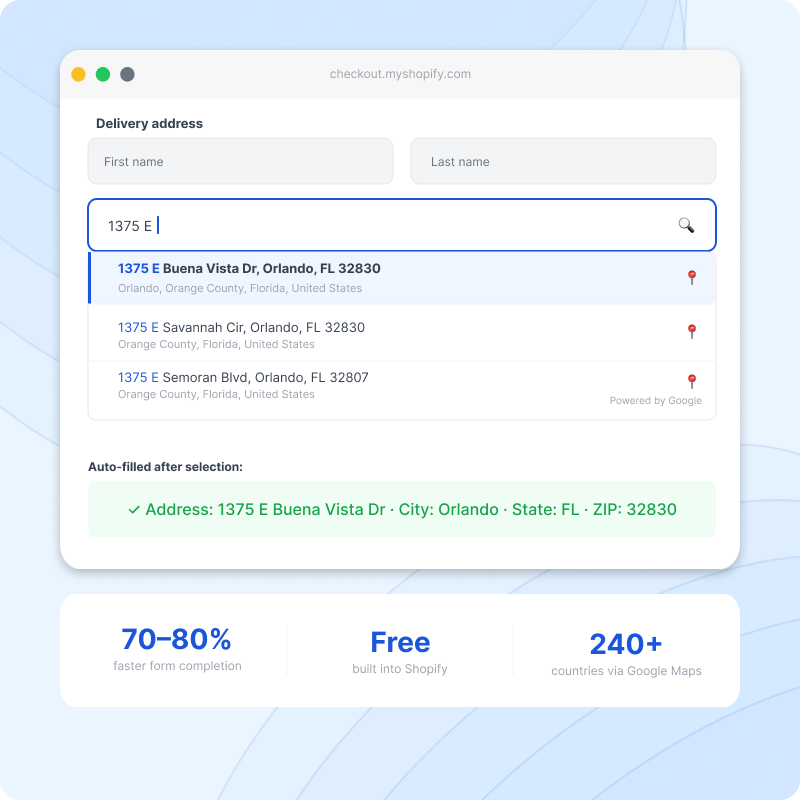
Address Guard Adds Carrier Validation
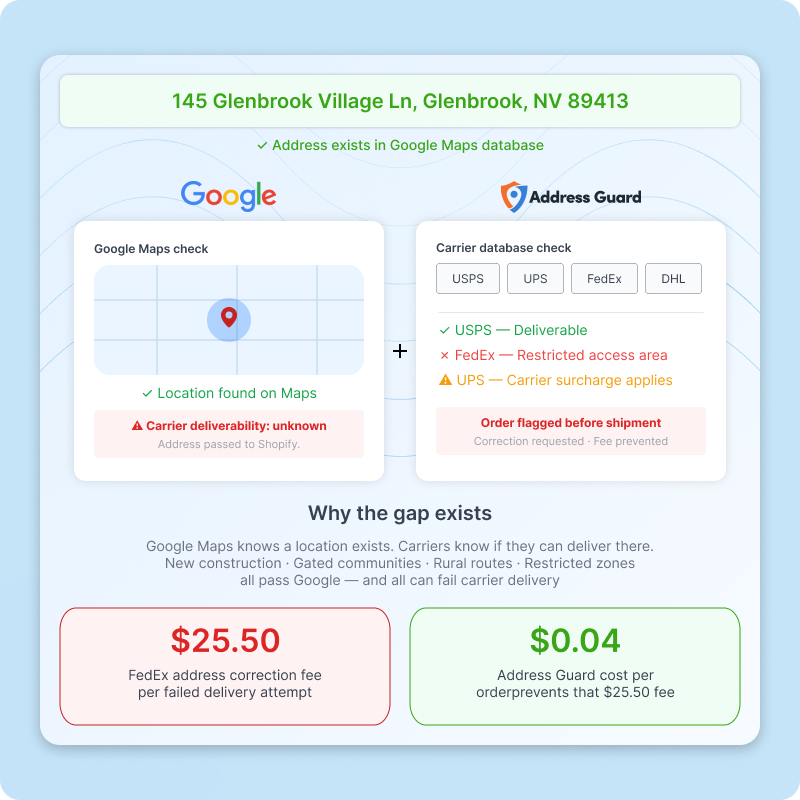
Google autocomplete checks if an address exists in the Google Maps database. Address Guard goes further by checking if the address is deliverable by USPS, UPS, FedEx, DHL, and other carriers.
An address can exist on Google Maps and still be undeliverable. New construction, demolished buildings, gated communities, restricted access areas — Google Maps knows the location exists but cannot determine if a carrier can deliver a package there.
- Address Guard validates against USPS, UPS, FedEx, and DHL databases
- Confirms an address is actually deliverable
- Detects addresses that will incur carrier correction fees
- Carrier-specific delivery restriction awareness
Address Guard Includes Rules Engine and Workflow Automation
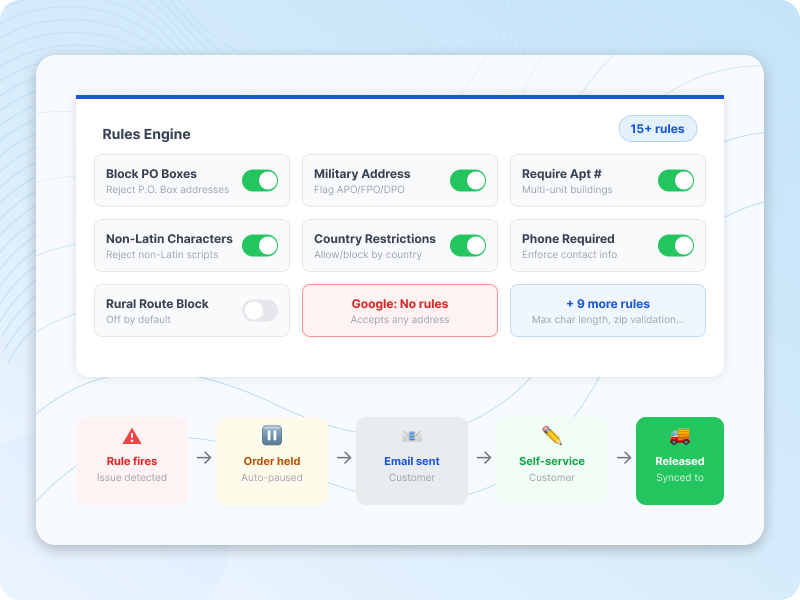
Google autocomplete has no concept of your shipping policies. Address Guard includes a rules engine that can block PO boxes, require apartment numbers for multi-unit buildings, detect military addresses, and handle non-Latin characters.
And when something is flagged, Address Guard automates the entire correction workflow: order holds, customer notifications, self-service correction links, and automatic sync back to your platform.
- Block PO boxes, military addresses, or restricted zones
- Require apartment or unit numbers
- Fulfillment hold capability
- Customer notification system
- Address correction workflow
- Email and phone validation
When Google Autocomplete Is Enough
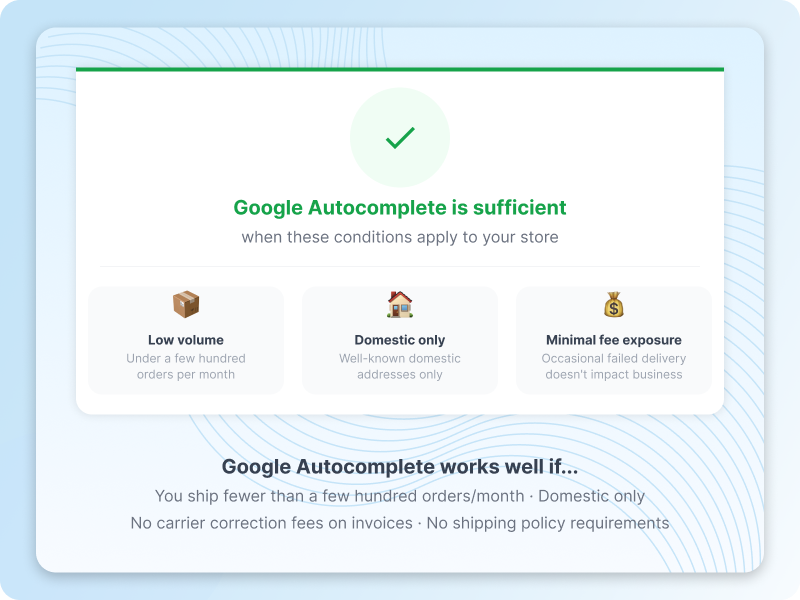
Google autocomplete works fine on its own if your store has very low shipping volume, minimal carrier fee exposure, and the occasional failed delivery doesn’t meaningfully impact your business.
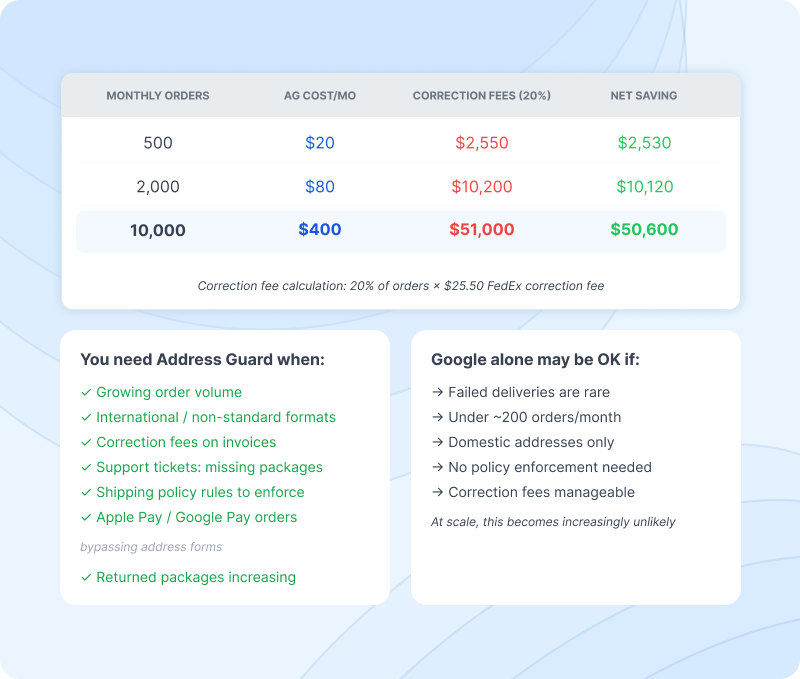
If you ship fewer than a few hundred orders per month, domestic only, and you’re not seeing significant carrier correction fees or returned packages, Google autocomplete may be sufficient for now.
- Very low order volume (under a few hundred per month)
- Domestic shipping only to well-known addresses
- Minimal carrier fee exposure
- Failed deliveries are rare and manageable
- No need to enforce shipping policy rules
When You Need Carrier-Validated Verification
Once your shipping volume grows, bad addresses become a line item. 1 in 5 online orders has an address issue. At scale, that means hundreds of failed deliveries, thousands in carrier correction fees, and a growing support ticket backlog.
The math is straightforward: Address Guard costs $0.05 per order. A single FedEx address correction fee is $25.50. A failed delivery costs $15-25 in direct costs. You need fewer than 1 in 400 orders to have an issue to break even — and the actual rate is closer to 1 in 5.
- Growing order volume where bad addresses create real costs
- International shipping with non-standard address formats
- Carrier correction fees showing up on invoices
- Support tickets about missing or delayed packages
- Shipping policy requirements (no PO boxes, apartment numbers required)
- Express checkout (Apple Pay, Google Pay) orders bypassing forms
The Best Approach: Use Both
Google autocomplete and Address Guard solve different problems. The best e-commerce stores use both.
Google Speeds Up Checkout
Address autocomplete reduces form completion time by 70-80%. Customers type less, make fewer typos, and convert more often. Keep using it.
Address Guard Prevents Failed Deliveries
Carrier-validated verification catches the addresses that need attention. Undeliverable locations, missing apartment numbers, PO boxes -- caught before you ship.
Together: Fast Checkout + Verified Addresses
Customers get fast form completion. You get carrier-validated addresses. Fewer failed deliveries, lower carrier fees, and happier customers.

Inkbox
“Super happy I found this app! Our undeliverable addresses and associated labor have dropped by 40% since starting to use Address Guard!”
Yaniv Logistics Manager test
Xena Workwear
“Address Guard works like a charm and the support is TRULY fantastic. The founder is responsive and a fast implementor of upgrades. I would say that this is the best support I’ve ever experienced with a 3rd party app, hands down.”
Dmitry Chief Operations Officer

Sunday Swagger
“The integration process and support from Address Guard has been nothing but Outstanding!! The solution has performed exactly as expected and had offered a significant improvement to our deliverability.”
Gary Chief Operations Manager
Frequently Asked Questions
Is Loqate more accurate than Address Guard for international addresses?
Can Address Guard handle the same volume as Loqate?
Yes. Address Guard scales from small Shopify stores to enterprise brands processing hundreds of thousands of orders per month. Enterprise plans include dedicated support, SLAs, and API access for custom integrations.
Do I need a developer to set up Address Guard? +
No. Address Guard installs from the Shopify App Store or BigCommerce marketplace with zero code. Configuration is done through a visual dashboard. Most merchants are validating addresses within 15 minutes of install.
Ready to Compare for Yourself?
Ready to Compare for Yourself?
Start with 100 free validations. No sales call required. See how Address Guard stacks up against Loqate for your store.